18.11.2026 | Event | Insight
COP17 in Yerevan put implementation firmly in focus. Governments acknowledged that progress towards the 2030 global biodiversity targets is insufficient and that action needs to accelerate. Discussions throughout the conference also pointed to a growing role for businesses and finance: the focus is increasingly shifting from understanding and reporting nature-related impacts to taking concrete action. We joined our Nordic partners in these discussions, shared lessons from our work with Nordic companies and published our biodiversity roadmap to 2030.
Held under the theme ‘Taking action for nature’, the UN Biodiversity Conference COP17 in Yerevan, Armenia brought the international community together around a central challenge: turning global biodiversity commitments into action. The conference recognised that progress towards the 2030 targets of the Kunming-Montreal Global Biodiversity Framework is insufficient and that implementation needs to accelerate.
For businesses and financiers, an important message was equally clear: there is already enough knowledge to start acting, even as data, methodologies and approaches continue to develop.
From global commitments to implementation
A key outcome was the Global Review decision, known as the Yerevan Pathway, which calls for countries to accelerate and scale up implementation of the 2030 biodiversity targets. With nearly 90% of parties having established national targets but fewer than half of the assessed aligned targets on track, COP17 highlighted the need to shift from setting ambitions to delivering measurable results.
Mobilising finance at greater scale remains central to implementation. Parties made progress on the future biodiversity finance framework and agreed to review existing funding mechanisms. The finance discussion was not only about mobilising more funding for nature, but also about redirecting financial flows, including reforming at least USD 500 billion in environmentally harmful subsidies.
For businesses and financial institutions, the direction is also becoming clearer: biodiversity needs to be integrated into investment, procurement, supply-chain and risk decisions. While data and methodologies continue to develop, companies can already identify their most material impacts and dependencies and start taking action where they matter most.
Progress was also made on Indigenous Peoples’ participation, reflecting the importance the Nordic countries place on Indigenous Peoples’ rights. Working arrangements for the new subsidiary body on Indigenous Peoples and local communities were provisionally adopted, allowing its work to begin. However, difficult questions concerning representation remain unresolved and will return to negotiations at COP18.
Nordic collaboration for nature
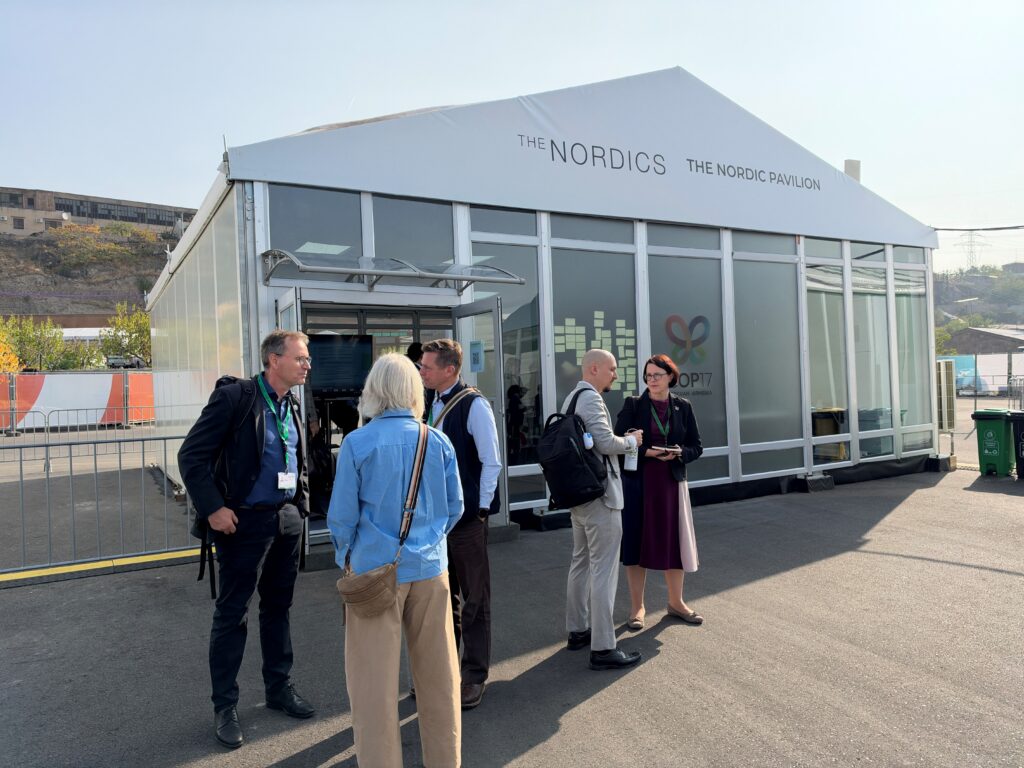
Nordic cooperation at COP17 brought together policymakers, businesses and experts to share solutions and help turn global biodiversity commitments into action. Nefco was a partner in the Nordic Pavilion alongside the Nordic Council of Ministers, the Embassy of Sweden in Armenia, State of Green, Danish Industry, the Confederation of Swedish Enterprise, Business Sweden, the Confederation of Finnish Industries EK and the UN Global Compact Nordic Network. Through events, discussions and knowledge-sharing, the Nordic Pavilion highlighted Nordic approaches to ecosystem restoration, sustainable use of natural resources and nature-positive innovation, while creating a platform for partnerships between the public and private sectors.
For Nefco, the Nordic Pavilion provided an opportunity to contribute our financing perspective and experience with Nordic green companies to the wider biodiversity discussion. In our speaking engagements, we focused particularly on how businesses can better identify their impacts and dependencies on nature and use these insights to guide practical decisions.
Turning nature ambition into business action
During the second week of COP17, we joined two Nordic Pavilion discussions on practical ways for businesses, particularly small and medium-sized companies (SMEs), to integrate nature considerations into their operations and investment decisions.
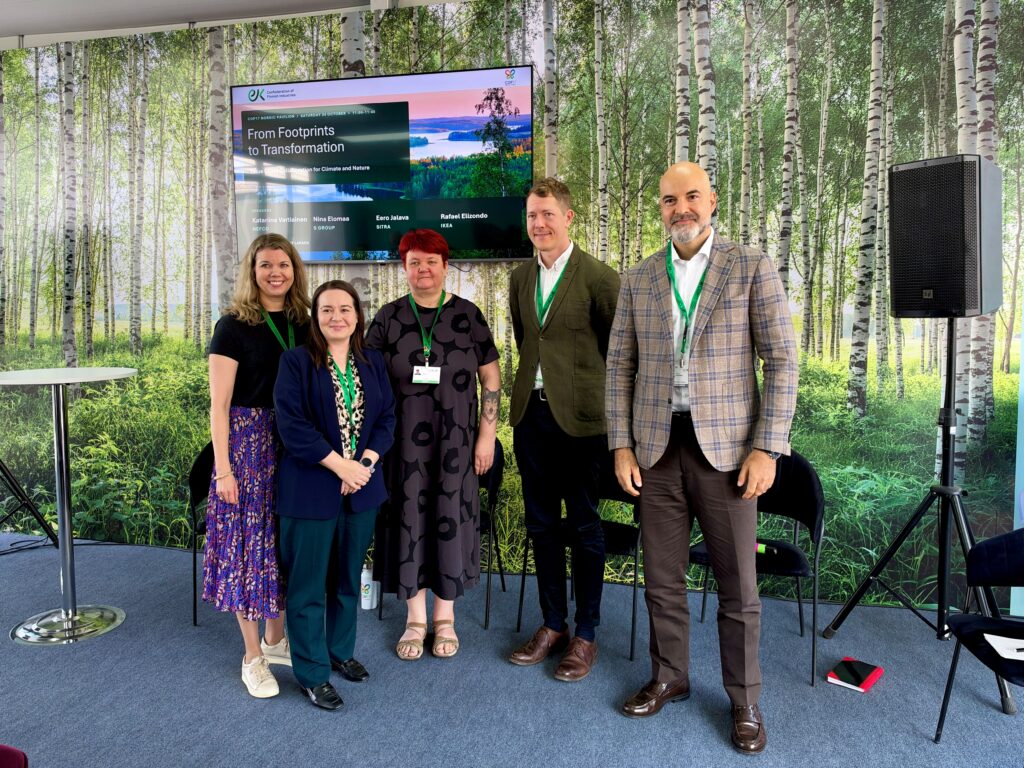
In the discussion organised by Confederation of Finnish industries EK From footprints to transformation: value-chain collaboration for climate and nature, our Katariina Vartiainen highlighted a pragmatic approach for SMEs: identify the most material impacts and dependencies, start there and improve over time. Collaboration with suppliers, customers, financiers and other partners can then help turn measurement into action across value chains.
A second discussion led by Danish Industry From risk to resilience: making nature core business focused on bringing biodiversity into decisions on investment, procurement, supply chains, risks and opportunities. The message from us was straightforward: companies should not wait for perfect data or a complete roadmap before starting.
Across both discussions, collaboration, practical examples and the right financial and policy incentives emerged as important ingredients for scaling business action on nature.
Our biodiversity roadmap to 2030
During COP17, we also published Nefco’s biodiversity roadmap to 2030, setting out our direction for strengthening biodiversity considerations in our work towards the end of the decade.
The timing in Yerevan underlined the connection between the international biodiversity agenda and practical implementation through financing and business action. It also supports the message we brought to our speaking engagements: progress on biodiversity requires moving from understanding impacts and dependencies to taking concrete action.
Read more:
- Our approach to biodiversity: www.nefco.int/biodiversity
- Nordic cooperation at COP17: COP17 | Nordic cooperation
- Convention on Biological Diversity – COP17: COP 17 / CP-MOP-12 / NP-MOP-06
- UN Biodiversity Conference charts Yerevan Pathway to accelerate global action for nature | Convention on Biological Diversity
- Global review of collective progress in the implementation of the Kunming-Montreal Global Biodiversity Framework

About the UN Biodiversity Conference COP17
The 17th meeting of the Conference of the Parties to the Convention on Biological Diversity (COP17) took place in Yerevan, Armenia, from 19 to 30 October 2026. It provided an important opportunity for countries to review progress since the adoption of the Kunming-Montreal Global Biodiversity Framework at COP15 in 2022. The framework includes four goals for 2050 and 23 targets for 2030, with the overarching ambition of halting and reversing biodiversity loss.
For more information, please contact: